
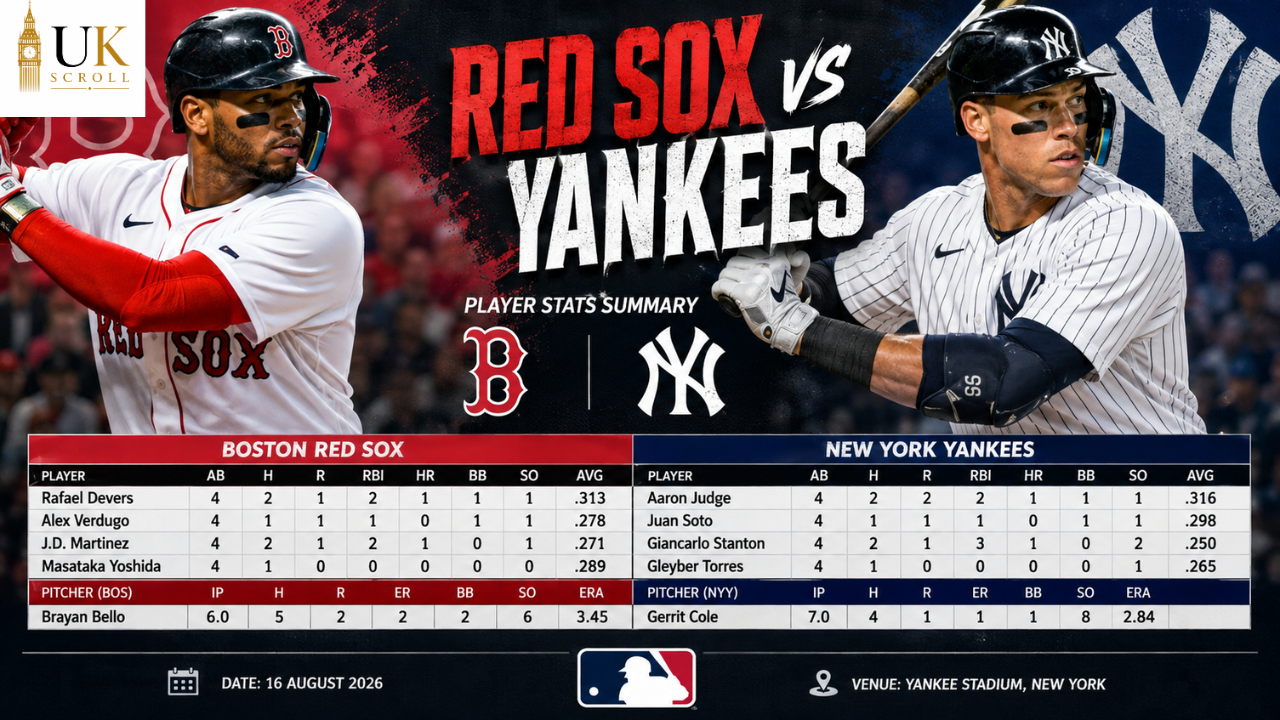
The Red Sox vs New York Yankees match player stats are among the most closely followed numbers in Major League Baseball. Whenever these two historic rivals meet, fans look beyond the final score to see which hitters produced, which pitchers controlled the game, and which players made the biggest difference.
Boston and New York have one of baseball’s most recognizable rivalries. Their games often feature star hitters, experienced starting pitchers, powerful bullpens, and high-pressure moments. Because of that, individual player statistics can tell a much deeper story than the scoreboard alone.
This guide explains the most important Red Sox vs New York Yankees match player stats, including batting, pitching, fielding, and advanced numbers. It also explains what to look for when comparing players before or after a Yankees-Red Sox matchup.
Why Red Sox vs Yankees Player Stats Matter
The Yankees and Red Sox have played countless memorable games, making their head-to-head statistics particularly interesting.
A player’s performance in one game can influence the result, but season-long numbers provide additional context. For example, a hitter who goes 2-for-4 may have had a strong night, but his overall batting average, on-base percentage, slugging percentage, and recent form can help explain whether that performance was expected.
Similarly, a starting pitcher can record a quality outing even without earning a win. Looking at innings pitched, earned runs, strikeouts, walks, and WHIP gives a clearer picture of pitching effectiveness.
When examining this rivalry, the most useful categories include:
- At-bats and hits
- Runs and RBIs
- Home runs
- Walks and strikeouts
- Batting average
- On-base percentage
- Slugging percentage
- Innings pitched
- Earned runs allowed
- Strikeouts and walks
- WHIP
- Saves and holds
- Fielding performance
Key Batting Stats to Watch
Batting numbers are usually the first place fans look when reviewing a Red Sox vs Yankees game.
A box score provides the basic information, but several statistics deserve special attention.
Hits and At-Bats
A player’s hits and at-bats show how frequently he reached base through a hit.
For example, a 2-for-4 performance means the player recorded two hits in four official at-bats. However, not every plate appearance becomes an at-bat. Walks and certain other outcomes are recorded differently.
Home Runs
Home runs can completely change a rivalry game. A solo homer gives one run, while a grand slam can bring four runs across the plate.
When reviewing Red Sox vs New York Yankees match player stats, home runs are especially important because both teams have traditionally featured dangerous power hitters.
RBIs
Runs batted in, commonly called RBIs, measure how often a batter is credited with bringing runners home or producing certain scoring situations.
A player with multiple RBIs may have been particularly influential even if another teammate recorded more hits.
On-Base Percentage
On-base percentage, or OBP, measures how frequently a player reaches base through hits, walks, and hit-by-pitches, with some exceptions.
It is useful because getting on base creates opportunities for teammates to score.
Slugging Percentage
Slugging percentage focuses more heavily on extra-base hits. Doubles, triples, and home runs contribute more than singles.
A player with a high slugging percentage can be a major threat whenever he steps into the batter’s box.
Important Player Stats at a Glance
| Stat | What It Shows | Why It Matters |
|---|---|---|
| AB | Official at-bats | Measures batting opportunities |
| H | Hits | Shows successful contact |
| R | Runs | Shows times a player scored |
| RBI | Runs batted in | Measures run production |
| HR | Home runs | Shows power |
| BB | Walks | Shows plate discipline |
| SO | Strikeouts | Measures missed opportunities for hitters |
| AVG | Batting average | Basic hitting efficiency |
| OBP | On-base percentage | Measures ability to reach base |
| SLG | Slugging percentage | Measures extra-base power |
| OPS | OBP + SLG | Useful overall offensive indicator |
| IP | Innings pitched | Measures pitching workload |
| ERA | Earned run average | Measures earned runs allowed |
| WHIP | Walks + hits per inning | Shows baserunner control |
| K | Strikeouts | Measures pitching dominance |
Starting Pitching Stats
Starting pitching can determine the direction of a Yankees-Red Sox matchup.
A strong starter can prevent early runs and allow the offense time to build a lead. A pitcher who struggles with command, however, can put his team under pressure before the middle innings.
The most important pitching statistics include innings pitched, earned runs, strikeouts, walks, hits allowed, and ERA.
Innings Pitched
Innings pitched show how long a starter remained in the game.
A pitcher who works deep into a game can reduce pressure on the bullpen. This becomes particularly valuable during a demanding MLB schedule.
Earned Runs
Earned runs are runs charged to a pitcher that are not the result of defensive errors or other circumstances that make them unearned.
A pitcher allowing fewer earned runs generally gives his team a better chance to win.
Strikeouts
Strikeouts are one of the easiest ways to evaluate a pitcher’s ability to finish at-bats.
A high strikeout total can indicate that a pitcher consistently generated swings and misses or successfully finished hitters with two strikes.
Walks and WHIP
Walks can become costly because they place additional runners on base without requiring a hit.
WHIP combines walks and hits allowed per inning and is therefore useful for evaluating how frequently a pitcher allows opposing batters to reach base.
Bullpen Performance Can Decide the Game
The starting pitcher is only part of the pitching story.
Once a starter leaves, relief pitchers take over. In close Yankees-Red Sox games, bullpen performance can become one of the biggest factors.
Important relief-pitching statistics include:
- Holds
- Saves
- Strikeouts
- Walks
- Earned runs
- Hits allowed
- Innings pitched
- WHIP
A reliever who enters with runners on base and escapes the inning without allowing a run may have a huge impact even if the box score does not immediately show it.
Defensive Player Stats
Offensive statistics receive plenty of attention, but defense can also decide a close game.
Fielding percentage, putouts, assists, and errors provide basic information about defensive performance. More advanced defensive metrics can provide additional context about range and run prevention.
A difficult defensive play that prevents an extra-base hit may be just as important to the final result as a big offensive hit.
For that reason, anyone analyzing Red Sox vs New York Yankees match player stats should not focus exclusively on batting totals.
Head-to-Head Matchups Add More Context
One useful way to study the rivalry is by looking at individual batter-versus-pitcher history.
For example, analysts may examine how a particular Yankees hitter has performed against a Boston pitcher or how a Red Sox batter has handled a specific Yankees starter.
However, small samples should be treated carefully.
If two players have faced each other only a few times, their head-to-head numbers may not provide enough evidence to predict future performance. Larger samples and recent form can provide more useful context.
Other factors can also matter, including:
- Ballpark conditions
- Weather
- Pitch selection
- Batter’s recent form
- Pitcher’s recent workload
- Defensive alignment
- Injuries
- Bullpen availability
- Home-field advantage
How to Compare Yankees and Red Sox Players
A simple way to compare players is to separate the analysis into offense, pitching, and defense.
Offensive Comparison
Look at:
- Hits
- Home runs
- RBIs
- Walks
- OBP
- SLG
- OPS
This combination gives a much better picture than batting average alone.
Pitching Comparison
For starting pitchers, examine:
- Innings pitched
- Earned runs
- Strikeouts
- Walks
- Hits allowed
- WHIP
- ERA
For relievers, saves and holds become particularly important when the game is close.
Why One-Game Stats Can Be Misleading
A single baseball game represents a very small sample.
A star hitter can go hitless in four or five at-bats and still be an excellent player. Likewise, a pitcher can have one poor outing despite producing strong numbers over an entire season.
This is why Red Sox vs New York Yankees match player stats should ideally be viewed alongside season statistics and recent performance.
For example, consider two hypothetical players:
| Player | Game Result | Season Context |
| Player A | 3-for-4, 2 HR | Strong season |
| Player B | 3-for-4, 0 HR | Average season |
| Player C | 0-for-4 | Strong season |
| Player D | 1-for-4 | Struggling season |
Player A clearly had the biggest offensive game in this example, but Player C’s poor individual game does not automatically mean he is the weaker player overall.
Baseball requires a balance between game-specific statistics and larger samples.
Advanced Metrics for Deeper Analysis
Fans who want more than traditional box-score numbers can explore advanced statistics.
OPS combines on-base percentage and slugging percentage, providing a quick measure of offensive production.
OPS+ goes a step further by adjusting offensive performance for league and ballpark conditions. A score above the league-average baseline indicates stronger-than-average offensive production.
For pitchers, metrics such as FIP and strikeout-to-walk ratio can provide additional insight into performance.
These advanced numbers are especially useful when comparing players who have different playing environments or workloads.
What to Check After a Yankees vs Red Sox Game
After the game, a complete statistical review should start with the final box score.
Check:
- Final score
- Starting pitchers
- Top hitters
- Home runs
- Total hits
- RBIs
- Strikeouts
- Walks
- Pitching innings
- Earned runs
- Saves
- Errors
Then compare those numbers with the players’ season averages.
This helps separate an unusual performance from a continuation of a player’s normal level of production.
Frequently Asked Questions
What are Red Sox vs New York Yankees match player stats?
These statistics show how individual Boston Red Sox and New York Yankees players performed during a particular matchup. They can include batting, pitching, fielding, and advanced statistics.
Which batting stats are most important in a Yankees vs Red Sox game?
Hits, home runs, RBIs, walks, OBP, SLG, and OPS are among the most useful offensive statistics. The importance of each statistic depends on what aspect of performance you are analyzing.
Which pitching stats should I check first?
Start with innings pitched, earned runs, strikeouts, walks, hits allowed, and WHIP. ERA can also help when comparing a pitcher’s longer-term performance.
Does one game determine which team has better players?
No. A single game is a small sample. A player can have an excellent season and still struggle in one matchup, so game statistics should be considered alongside season-long numbers.
Why are Yankees vs Red Sox player statistics so popular?
The rivalry has a long history and attracts significant attention from baseball fans. Individual player performances can also have a major effect on the outcome of these highly competitive games.
Where can I find official player statistics?
Official MLB resources and established baseball statistics providers are generally the best places to verify game-specific box scores, player statistics, standings, and season totals.
Final Thoughts
The Red Sox vs New York Yankees match player stats provide a detailed way to understand what happened during one of baseball’s biggest rivalries. While the final score tells you which team won, player statistics explain how the game unfolded.
For hitters, look at hits, home runs, RBIs, walks, OBP, SLG, and OPS. For pitchers, focus on innings, earned runs, strikeouts, walks, WHIP, and ERA. Defensive statistics can then add another layer to the analysis.
Most importantly, avoid judging a player entirely from one game. Combining matchup statistics with recent form and season-long performance provides a more balanced view of how Yankees and Red Sox players are performing.
Also Read: Geometry Learn V3: A Complete Guide to Understanding Its Features, Uses, and Learning Experience
About the Author





1 thought on “Red Sox vs New York Yankees Match Player Stats: Complete MLB Guide”