
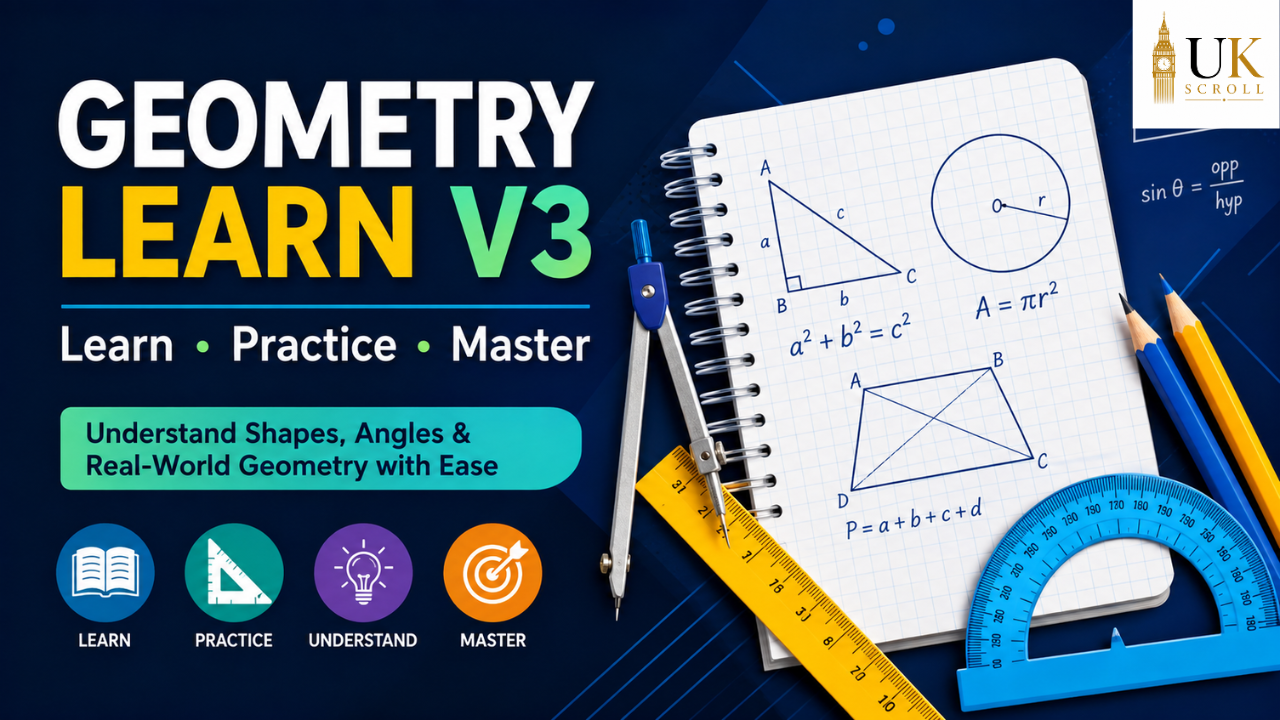
If you have recently searched for geometry learn v3, you may be looking for information about a newer version of a geometry learning resource, platform, tool, or educational experience. The phrase is relatively specific, which can make it difficult to understand exactly what it refers to, especially when different websites use similar names for geometry-related learning materials.
Geometry is one of the most important areas of mathematics because it teaches students how shapes, sizes, angles, distances, positions, and spatial relationships work. A well-designed digital learning resource can make these ideas considerably easier to understand by combining explanations, visual examples, practice activities, and interactive elements.
This guide takes a practical look at geometry learn v3, what learners may expect from a third-version geometry learning resource, how it can support mathematical understanding, and how to approach geometry topics more effectively. Rather than relying on complicated terminology, the goal is to make the subject easier to follow for students, parents, teachers, and anyone interested in improving their geometry skills.
What Is Geometry Learn V3?
The term geometry learn v3 appears to describe a third-version or updated geometry learning resource. The “V3” designation commonly means “version 3,” suggesting that the resource has been revised, expanded, or redesigned from an earlier version.
However, the exact features of a resource called Geometry Learn V3 can vary depending on the website, application, educational project, or platform using the name. Because of this, users should check the official source associated with the particular version they are trying to access.
From a learning perspective, the idea behind a modern geometry resource is straightforward: make mathematical concepts easier to understand through structured lessons and visual learning.
A useful geometry learning system can help users study topics such as:
- Points, lines, and line segments
- Angles and their measurements
- Triangles
- Quadrilaterals
- Polygons
- Circles
- Perimeter and area
- Volume and surface area
- Coordinate geometry
- Transformations
- Symmetry
- Similarity and congruence
- Geometric proofs
The value of a resource is not simply the number of topics it contains. Its effectiveness depends on whether it explains concepts clearly and gives learners enough opportunities to apply what they have learned.
Why Geometry Can Be Difficult for Students
Geometry can seem confusing because it combines visual thinking with mathematical reasoning.
In arithmetic, students often work directly with numbers. Geometry requires them to understand how numbers relate to shapes and space.
For example, knowing that a triangle has three sides is simple. The challenge becomes greater when a student has to calculate an unknown angle, determine the area, or prove that two triangles are congruent.
Several factors can make geometry challenging:
Visual Interpretation
Students need to recognize relationships between different parts of a diagram. A drawing may contain several lines, angles, and shapes at the same time.
Mathematical Formulas
Geometry includes many formulas. Memorizing them without understanding their purpose can make problem-solving difficult.
Logical Reasoning
Some geometry questions require multiple steps. Students must identify known information, determine what is missing, and select an appropriate method.
Proofs
Geometric proofs can be particularly challenging because they require students to explain why a statement is true rather than simply provide an answer.
A structured learning resource can help by presenting each concept gradually.
How a Version 3 Geometry Learning Resource Can Help
An updated version of an educational resource can potentially improve the learning experience by making information easier to navigate and understand.
A strong geometry learning platform generally benefits from several features.
| Learning Feature | How It Can Help |
|---|---|
| Visual diagrams | Makes shapes and relationships easier to understand |
| Step-by-step explanations | Breaks difficult problems into manageable stages |
| Practice questions | Helps learners apply concepts |
| Interactive activities | Encourages active participation |
| Progress tracking | Helps learners identify areas that need improvement |
| Worked examples | Shows how mathematical problems can be solved |
| Organized lessons | Creates a logical learning path |
| Review material | Reinforces previously learned concepts |
The important point is that technology should support mathematical understanding rather than replace it.
Students still need to think through problems themselves. Digital tools are most useful when they make difficult ideas clearer.
Core Geometry Topics to Learn
Whether you are using Geometry Learn V3 or another educational resource, mastering the fundamentals should come first.
Points, Lines, and Segments
A point represents an exact location. A line extends indefinitely in both directions, while a line segment has two endpoints.
These concepts may appear basic, but they form the foundation for more advanced geometry.
Understanding how lines interact also introduces students to concepts such as parallel and perpendicular lines.
Angles
Angles describe the amount of rotation between two rays.
Common types include:
- Acute angles
- Right angles
- Obtuse angles
- Straight angles
- Reflex angles
Students should learn both how to identify angles and how to calculate unknown measurements.
For example, angles on a straight line add up to 180 degrees, while the angles around a point total 360 degrees.
Triangles
Triangles are among the most important shapes in geometry.
They can be classified by their sides as:
- Equilateral
- Isosceles
- Scalene
They can also be classified according to their angles:
- Acute
- Right
- Obtuse
The interior angles of every triangle add up to 180 degrees.
Understanding this rule makes many triangle problems much easier.
Quadrilaterals
A quadrilateral has four sides.
Important examples include:
- Squares
- Rectangles
- Parallelograms
- Rhombuses
- Trapezoids
- Kites
Each has its own characteristics involving sides, angles, symmetry, and diagonals.
Learning those characteristics helps students identify shapes quickly and select the correct formulas.
Circles
Circle geometry introduces concepts such as radius, diameter, circumference, chord, arc, and sector.
Two fundamental formulas are:
Circumference = 2πr
Area = πr²
Understanding what each variable represents is just as important as memorizing the equations.
Area, Perimeter, and Volume
Many geometry exercises focus on measurement.
Perimeter
Perimeter is the total distance around a two-dimensional shape.
For a rectangle:
Perimeter = 2(length + width)
For a square:
Perimeter = 4 × side
Area
Area measures the amount of two-dimensional space inside a shape.
For a rectangle:
Area = length × width
For a triangle:
Area = ½ × base × height
Different shapes require different formulas, so learners should understand which measurements are needed before beginning a calculation.
Volume
Volume measures the amount of three-dimensional space occupied by an object.
For a rectangular prism:
Volume = length × width × height
Volume becomes increasingly important when students move from basic geometry toward three-dimensional mathematics.
Coordinate Geometry
Coordinate geometry connects geometry with algebra.
A coordinate plane uses horizontal and vertical axes to identify locations. Points are normally represented using ordered pairs such as (x, y).
Once students understand coordinates, they can study:
- Distance between points
- Midpoints
- Slopes
- Equations of lines
- Graphs
- Geometric transformations
This area is especially useful because it demonstrates how algebraic equations can describe geometric relationships.
Transformations and Symmetry
Transformations describe how a shape changes its position or orientation.
The major transformations include:
- Translation
- Rotation
- Reflection
- Dilation
A translation moves a figure without changing its orientation.
A rotation turns a figure around a fixed point.
A reflection creates a mirror image.
A dilation changes the size of a figure while maintaining its overall shape.
These ideas help students understand symmetry and spatial relationships.
Congruence and Similarity
Two figures are congruent when they have the same shape and size.
Two figures are similar when they have the same shape but may have different sizes.
For example, two rectangles can be similar if their corresponding side lengths have the same ratio.
Understanding similarity is useful for:
- Scale drawings
- Maps
- Models
- Indirect measurements
- Real-world design problems
Congruence and similarity also become important when students begin working with geometric proofs.
Understanding Geometric Proofs
Proofs are sometimes viewed as one of the hardest parts of geometry.
The purpose of a proof is to establish that a mathematical statement must be true based on accepted facts and logical reasoning.
A typical proof may involve:
- Identifying the information provided.
- Determining what must be proven.
- Finding relevant geometric relationships.
- Applying definitions, properties, or theorems.
- Connecting each step logically.
- Reaching the required conclusion.
Students should avoid treating proofs as something that must simply be memorized. The better approach is to understand why each step follows from the previous one.
How to Study Geometry More Effectively
Using an educational resource is helpful, but your study method matters too.
Start with the basics rather than immediately jumping into advanced problems.
A practical learning sequence might look like this:
Step 1: Learn the terminology
Understand words such as vertex, angle, radius, diameter, parallel, perpendicular, congruent, and similar.
Step 2: Study diagrams
Look carefully at shapes and identify their important properties.
Step 3: Learn formulas
Understand what each formula calculates and what measurements it requires.
Step 4: Work through examples
Follow complete solutions and identify the reasoning behind each step.
Step 5: Solve problems independently
Try questions without looking at the answer immediately.
Step 6: Review mistakes
Incorrect answers can reveal exactly which concept needs more practice.
This approach is generally more effective than simply trying to memorize large numbers of formulas.
Geometry Learn V3 for Different Types of Learners
A digital geometry resource can be useful for different learners, but people may use it in different ways.
Students
Students can use structured lessons to review classroom topics, prepare for tests, or practice concepts they find difficult.
Parents
Parents can use educational resources to understand what their children are studying and provide additional practice at home.
Teachers
Teachers may use digital resources as supplementary material for explanations, demonstrations, or independent practice.
Independent Learners
People studying mathematics outside a formal classroom can use geometry lessons to build their knowledge gradually.
The most effective approach is to match the learning method with the individual’s needs rather than assuming one resource works equally well for everyone.
Common Mistakes When Learning Geometry
Even students who understand basic geometry can make avoidable mistakes.
One common problem is using the wrong formula. A student may remember a formula but fail to identify whether the question asks for area, perimeter, or volume.
Another mistake is ignoring units.
If a problem asks for area, the answer should normally use square units. Volume requires cubic units.
Students may also misread diagrams. Not every drawing is necessarily to scale, so mathematical information provided in the question should take priority over visual appearance.
Other frequent mistakes include:
- Confusing radius with diameter
- Forgetting to divide by two when using the triangle-area formula
- Mixing up corresponding sides
- Assuming shapes are congruent without sufficient evidence
- Skipping steps in calculations
- Rounding too early
- Ignoring negative coordinates
- Memorizing formulas without understanding them
Slowing down and checking each step can prevent many of these errors.
Tips for Using Online Geometry Resources Safely and Effectively
Before using any website or application identified as Geometry Learn V3, check that you are using a legitimate source.
Look for clear information about:
- Who operates the resource
- What the resource is designed to teach
- Whether the content is regularly maintained
- What information the platform collects
- Whether registration is required
- Whether downloads are necessary
Avoid downloading unknown files simply because a page claims they are required for access.
For younger learners, parents or teachers can also review unfamiliar educational platforms before use.
The safest approach is to rely on established educational sources and verify unusual claims through reliable references.
Can Geometry Learning Tools Replace a Teacher?
Digital resources can be valuable, but they do not completely replace teachers.
A teacher can recognize when a student is confused and explain the same idea in a different way. They can also provide personalized feedback and identify misunderstandings that an automated system may not detect.
Online tools are therefore best viewed as additional learning support.
A student might learn a concept in class, use a digital resource for extra explanation, complete practice problems, and then ask a teacher about anything that remains unclear.
Combining these approaches can create a stronger learning experience.
How to Improve Your Geometry Problem-Solving Skills
Geometry becomes easier with consistent practice.
Instead of solving dozens of random questions without reflection, focus on understanding the process.
When approaching a problem, ask:
- What information is given?
- What am I being asked to find?
- Which shape or relationship is involved?
- Which formula or theorem applies?
- What measurements do I already know?
- What intermediate step is necessary?
- Does my final answer make sense?
Drawing your own diagram can also help when the original question is difficult to visualize.
Writing down known information before calculating is another simple but effective technique.
Real-World Uses of Geometry
Geometry is not limited to mathematics classrooms.
It appears in many everyday activities and professional fields.
Architecture
Architects use geometry to plan buildings, rooms, structures, and spatial layouts.
Engineering
Engineers rely on geometric principles when designing machines, bridges, products, and infrastructure.
Construction
Builders use measurements, angles, area calculations, and spatial relationships every day.
Computer Graphics
Digital graphics and game development depend heavily on geometric concepts involving coordinates, shapes, movement, and transformations.
Design
Interior designers, product designers, and graphic designers frequently use geometric relationships when creating layouts and objects.
Navigation
Maps and positioning systems also rely on mathematical concepts related to distance, coordinates, and spatial relationships.
These applications show why learning geometry is useful beyond passing a mathematics exam.
A Simple Geometry Learning Routine
A consistent routine can make studying more manageable.
Try dividing a study session into short sections:
- 10 minutes: Review previous concepts.
- 15 minutes: Learn a new concept.
- 15 minutes: Follow worked examples.
- 20 minutes: Solve practice questions.
- 5 minutes: Review mistakes.
The exact schedule can be adjusted depending on age, school requirements, and available time.
The important part is consistency.
Studying geometry for a reasonable amount of time several days a week can be more useful than trying to learn everything in one long session.
Geometry Learn V3: What Should You Look For?
If you are evaluating a resource called Geometry Learn V3, focus less on the version number and more on the actual educational value.
A useful resource should ideally provide:
- Clear explanations
- Accurate mathematical information
- Helpful diagrams
- Progressive difficulty
- Practice opportunities
- Explanations of incorrect answers
- Easy navigation
- Appropriate privacy practices
- Reliable educational content
A newer version is not automatically better simply because it has a higher version number.
The quality of the explanations and learning experience matters much more.
Frequently Asked Questions
What does Geometry Learn V3 mean?
Geometry Learn V3 generally suggests a third version of a geometry-focused learning resource. The exact meaning depends on the platform, website, or educational project using the name, so users should verify details through the relevant official source.
Is Geometry Learn V3 suitable for beginners?
A geometry learning resource can be useful for beginners when it starts with fundamental concepts such as points, lines, angles, and basic shapes. Learners should choose lessons that match their current mathematical level.
What geometry topics should I learn first?
Beginners should normally start with basic terminology, angles, triangles, quadrilaterals, perimeter, and area. Once these concepts are comfortable, they can move toward circles, coordinate geometry, transformations, similarity, and proofs.
Can online geometry tools help with schoolwork?
Yes. Digital learning resources can provide explanations, examples, and additional practice. However, students should use them to understand the solution rather than simply copying answers.
Why are geometry diagrams important?
Diagrams make relationships between shapes, lines, and angles easier to visualize. They can help learners identify known information and understand how different parts of a problem are connected.
How can I get better at geometry?
Regular practice is one of the best ways to improve. Learn the underlying concepts, work through examples, solve problems independently, and carefully review mistakes. Understanding why an answer is correct is more valuable than memorizing answers.
Final Thoughts
Geometry Learn V3 can be approached as a useful search term for people looking for an updated geometry learning experience, but the exact features and identity of any specific resource should always be confirmed through its official source.
Regardless of the platform, effective geometry learning comes down to the same fundamentals: understand the terminology, visualize relationships, learn formulas with context, practice regularly, and develop logical problem-solving skills.
Geometry may appear difficult at first because it combines numbers, diagrams, formulas, and reasoning. With a structured approach, however, those pieces gradually become connected. Once students understand why a formula or theorem works, solving new problems becomes much easier.
Whether you are preparing for a school examination, reviewing forgotten mathematics, or simply trying to strengthen your spatial reasoning, a good geometry learning resource can provide useful support. The key is to use it actively—study the explanation, attempt the problem yourself, learn from mistakes, and continue building your understanding one concept at a time.
Also Read: Tim Montgomerie Illness: What Is Publicly Known About His Health?
About the Author





1 thought on “Geometry Learn V3: A Complete Guide to Understanding Its Features, Uses, and Learning Experience”